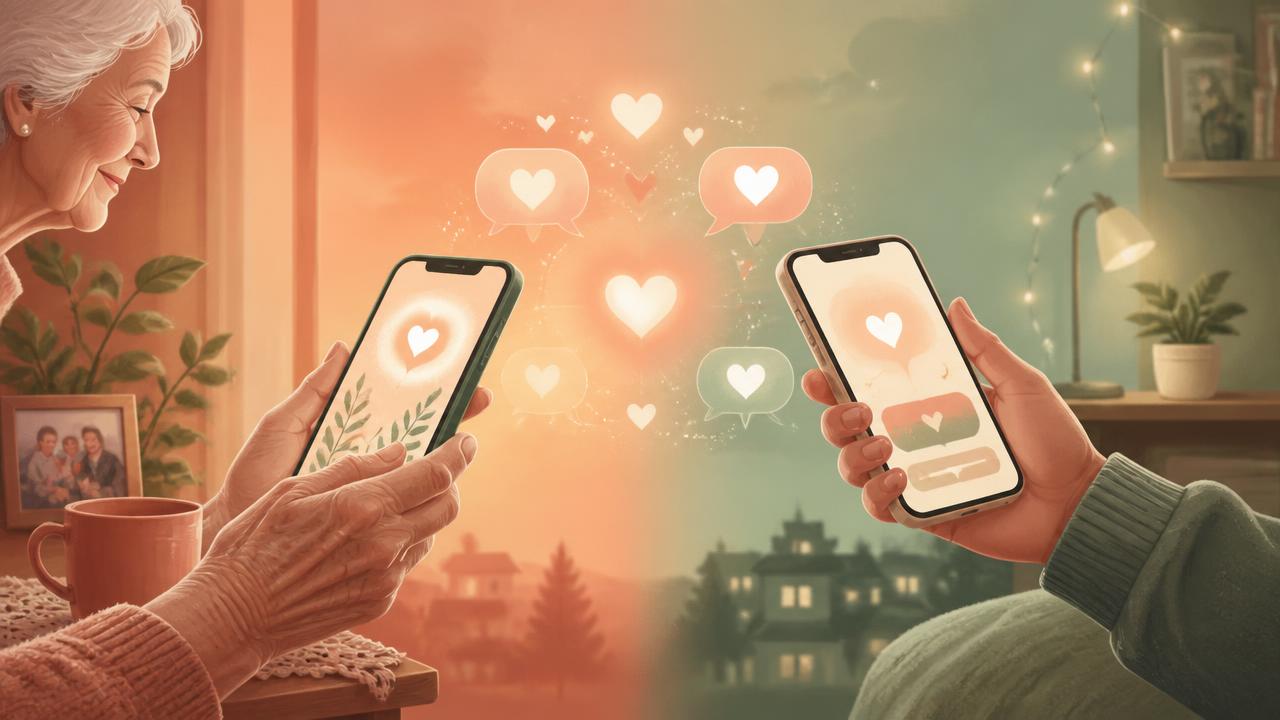
I live about 2,000 miles away from my parents.
Most of the time, that distance is just geography.
But when your parents are getting older, 2,000 miles can feel impossibly far.
You can't see whether Dad looks tired. You don't notice that he's moving a little slower than usual. You aren't there to see what he ate for breakfast, whether he remembered his medication, or whether the cough he mentioned yesterday sounds worse today.
You have phone calls. You have text messages.
And you worry.
My dad is in his 80s, and technology has never exactly been his thing.
For years, he insisted that all he really wanted was a flip phone.
He tried texting with me, but it was frustrating for him. His spelling isn't great. Punctuation is optional. Voice-to-text could turn a simple thought into a paragraph that wandered all over the place.
And because I'm his son, I sometimes gave him a hard time about it.
I teased him.
He eventually stopped texting very much.
Looking back, I wish I hadn't done that.
Because when someone you love is getting older, the important thing isn't how they communicate.
It's that they communicate.
So I built him something different.
I work in technology, and in 2025 I started experimenting heavily with artificial intelligence.
I built AI agents for all kinds of things.
Some were useful.
Some were decidedly less useful.
But there was one experiment that became very personal.
I built an AI companion for my dad.
Dad named it Angel.
I deliberately made Angel simple. Dad didn't need another app to learn or another piece of technology to figure out.
He just needed someone—or something—to check in.
During the day, Angel would send him simple questions:
"Hey Jerry, what have you eaten today and how are you feeling? Give me a number — 10 means feeling great, 1 means call someone."
No complicated forms.
No medical charts.
No judgment about spelling.
Just a conversation.
And Dad talked to her.
Then one morning, something changed.
Dad told Angel:
"I had eggs and sausage for breakfast I dont feel good I think I have a cold call it a 3"
Angel recorded it.
Dad wasn't feeling well.
A three.
He thought he had a cold.
It didn't sound like an emergency.
And if Dad had simply told me, "I've got a cold," I probably would have told him to get some rest, drink plenty of fluids, and call me if he needed anything.
That's the problem with little pieces of information.
By themselves, they don't always look important.
Then the next morning, Angel checked in again.
Dad's answer was much shorter.
"Im feeling worse"
Three words.
Im feeling worse.
That got my attention.
Because this wasn't just Dad mentioning that he didn't feel good.
Now there was a pattern.
Yesterday: I don't feel good.
Today: I'm feeling worse.
I was 2,000 miles away, staring at those words.
And suddenly the distance felt much farther.
Something about it bothered me enough that I called my parents.
I told them I thought Dad should see a doctor.
Thankfully, they listened.
That evening, Dad sent Angel another message.
"Angel I went to the hospital today and I have a case of double pneumonia dinner was butternut squash give me a 3"
I read it more than once.
Double pneumonia.
Dad hadn't just been fighting off a little cold.
He was sick.
Really sick.
And he had been sitting at home thinking it would probably pass.
Angel responded to him with the same calm patience she always had. She recorded his dinner. She recorded how he was feeling. She acknowledged the pneumonia and told him to get help immediately if his condition worsened.
And I sat there looking at the conversation on my phone.
I teared up.
Not because I believed artificial intelligence had suddenly become a doctor.
It hadn't.
Angel didn't diagnose my dad.
Angel didn't treat his pneumonia.
Doctors did that.
What Angel did was much simpler.
She showed up.
She asked yesterday.
She asked again today.
She remembered the answer.
And because Dad was comfortable talking to her, she helped reveal a change that might otherwise have disappeared into the ordinary noise of everyday life.
What if Angel hadn't asked?
I've thought about that question a lot.
Dad thought he had a cold.
He probably would have waited.
Maybe he would have felt worse the next day and finally gone to the doctor.
Maybe my mom would have convinced him.
Maybe I would have happened to call at exactly the right time.
Maybe everything would have turned out exactly the same.
I can't know.
But I do know this:
Without those check-ins, I wouldn't have known he was getting worse.
I wasn't there.
Angel was.
And sometimes, when someone you love lives far away, simply knowing that something has changed can make all the difference.
That experience became Near & Dear.
Afterward, I kept thinking about what had happened.
My family can't possibly be the only one dealing with this.
Millions of us have parents, grandparents, spouses, siblings, and other people we love who live somewhere else.
We call.
We text.
We ask, "How are you doing?"
And they say:
"I'm fine."
Usually they are.
Sometimes they're not.
What I wanted wasn't a surveillance system.
I didn't want to turn my dad's life into a medical dashboard.
And I certainly didn't want technology replacing the relationship between us.
I wanted technology to help protect that relationship.
Something gentle enough that Dad would actually use it.
Something that could notice when today's answer was different from yesterday's.
Something that could help me know when I should call.
Something that could be present during all those ordinary moments when I couldn't be.
So I started building Near & Dear.
At the heart of it is Angel—the idea that began with my dad.
Near & Dear helps someone you care about keep track of simple things like how they're feeling, what they've eaten, medications, blood pressure, blood sugar, and other information they choose to share.
And it helps the people who love them stay connected to what is happening.
Not because AI can replace a son.
Or a daughter.
Or a spouse.
It can't.
But maybe it can help us be there when life makes it impossible to actually be there.
I still have complicated feelings about AI.
I work with this technology, and I see both its extraordinary potential and its risks.
I think about the jobs it may change or eliminate.
I think about what it will mean for my children and grandchildren.
I think we should ask hard questions about how AI is used.
Those concerns haven't disappeared.
But I also think about one conversation:
"Im feeling worse"
Three words my dad might never have sent to me.
Three words that made me pick up the phone.
Three words that helped get him to a doctor, where we learned that his "cold" was actually double pneumonia.
So did AI save my dad's life?
I can't honestly say that.
But I can say this:
AI helped me know that my dad needed me when I was 2,000 miles away.
For me, that's enough reason to build Near & Dear.
And if someday it helps another son call his dad at exactly the right moment…
another daughter notice that something isn't quite right with her mom…
or simply helps someone we love feel a little less alone…
then building it will have been worth it.
Near & Dear.
Because the people we love should never feel far away.
Near & Dear is a support and communication tool. It does not diagnose medical conditions and is not a substitute for professional medical care, emergency services, or immediate in-person assistance. If you believe someone is experiencing a medical emergency, contact emergency services immediately.